What are implant-supported dentures?
Implant-supported dentures — commonly called implant dentures — are an oral appliance that replaces missing teeth in one or both jaws. They may be used when a person has no teeth but still has enough bone to support dental implants. These dentures are anchored onto dental implants which are secured firmly into the jawbone. Once the dental implants are placed and have healed, the dentures are attached to them. Implant dentures are more secure than conventional dentures.
Patients have several choices when getting implant-supported dentures in Rochester, NY, including implant-supported lower overdentures (retained by two implants), implant-supported upper overdentures (retained by four implants), and implant-supported removable partial dentures (upper or lower). The health of your jawbone, your medical history, and your personal preferences will determine which type is right for you. If you have any questions about tooth replacement and the various types of implant-supported dentures, please contact our office to set up an appointment.
Dr. Isaac Kuyunov is a dental implant dentist who provides patients who have lost all of their teeth with a more permanent solution to traditional dentures. Implant-supported dentures offer a more stable, natural feel, help prevent bone loss, and allow patients to eat, drink, and speak more naturally and comfortably.
What types of implant dentures are there?
There are three types of implant-supported dentures. These options differ based on how they are secured, the number of implants required, and whether they can be removed by the patient.
1. Implant-Supported Complete Lower Dentures (Overdentures) Retained by Two Implants
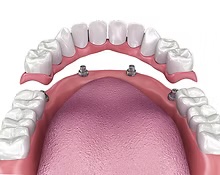
This complete lower denture is removable and is attached to two permanent implants anchored in the jawbone. Patients can remove the denture at will for cleaning or sleeping and place it back when ready to use. The main benefit of this type is the added retention provided by the two implants.
Two-Implant Complete Lower Dentures Are Recommended Over Traditional Dentures
Most dentists and prosthodontists recommend lower dentures with two implants. Dr. Isaac Kuyunov believes that implant dentures are a better choice than conventional dentures for replacing missing teeth. In 2002, a group of experts from around the world met to discuss the proper restorative standard for edentulous patients (those with complete loss of all their natural teeth) and published the McGill Consensus Statement on Overdentures. It was noted that patients found the lower complete denture with two implants to be more stable than a regular denture without implants. This statement strongly recommended that the two-implant overdenture is the new minimal standard of care for people who have no teeth in their lower jaw.
2. Implant-Supported Complete Upper Dentures (Overdentures) Retained by Four Implants
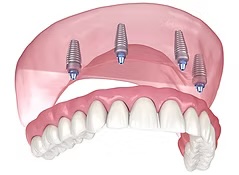
This type of implant denture has an attachment mechanism that connects it to the implants to hold it in place. It can attach directly to the implants or attach to a bar that is anchored to the implants. A complete upper overdenture retained by four implants also provides patients with the ability to remove it at will to clean it and allow their gums to rest.
This complete upper denture features an open palate design, which has many benefits. The most significant is that patients can enjoy the taste of foods more fully, as the palate contains numerous taste buds.
3. Implant-Supported Removable Partial Dentures (Upper or Lower)
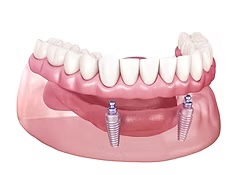
Implant-supported removable partial dentures are attached to implants for added retention. These dentures snap onto dental implants in your jawbone. The benefits include added retention and the absence of metal clasps that are present on conventional partial dentures and can often show. It is still necessary to remove them for cleaning, maintenance, and at bedtime, as you would with conventional partial dentures.
The McGill Consensus Statement Conclusion
“The evidence currently available suggests that the restoration of the edentulous mandible with a conventional denture is no longer the most appropriate first choice prosthodontic treatment. There is now overwhelming evidence that a 2-implant overdenture should become the first choice of treatment for the edentulous mandible.”
Important Takeaways from the McGill Statement
- Survival of titanium implants in the anterior region of the lower jaw is very high.
- Implants reduce the rate of bone resorption in the anterior mandible.
- Mandibular two-implant overdentures have been shown superior to conventional dentures in many clinical trials.
- Participants are significantly more satisfied with two-implant overdentures than with new conventional dentures.
- Patients find two-implant overdentures significantly more stable, providing better chewing of various foods and being more comfortable to speak with.
- Patients rate their quality of life significantly better with mandibular two-implant overdentures than with conventional dentures.
- More and more evidence shows that people who receive mandibular two-implant overdentures modify and improve their diet, while those who wear conventional dentures do not — an improvement that may have a strong positive impact on general health, particularly for senior adults who are vulnerable to malnutrition.
What are the advantages of implant dentures compared to conventional dentures?
There are many benefits of getting implant-supported dentures in Rochester, NY if you are considering replacing missing teeth. Here are some of the most significant advantages of implant dentures over conventional dentures:
- Prevents Bone Loss: A common problem with conventional dentures is bone loss, which can give patients significant aesthetic changes over time, such as facial features appearing to collapse inward. Implant-supported dentures help preserve your jawbone structure. When you chew and bite, the force travels through the implants and into the bone, mimicking the stimulation of natural tooth roots and encouraging the jawbone to renew and regenerate itself.
- Increases Stability and Retention: Conventional dentures rest above the gum and are held in place by suction, sometimes requiring adhesive. Implant-supported overdentures snap onto dental implants and provide far more stability.
- Can Improve Overall Nutrition: With more stable dentures, you can eat a wider variety of foods — including more fruits and vegetables — which can contribute to your overall health.
- Attractive, Natural Appearance: Implant dentures look like natural teeth. Patients smile with more confidence knowing that their dentures are secure and stable.
Who is a good candidate for implant dentures?
Candidates for implant dentures typically have lost most or all of their teeth, possess adequate jawbone density to support implants, and maintain overall health sufficient for surgery. It is important to practice good oral hygiene, avoid tobacco use, and understand the procedure and recovery process. A thorough dental and medical assessment is conducted to determine eligibility. Here are the key criteria:
- You are missing several or all upper or lower teeth.
- You have enough healthy bone in your jaw to support implants.
- You want to improve the function of your teeth and the appearance of your smile.
- You want to improve the retention and stability of your dentures.
- You prefer an open palate with your upper denture to better enjoy the taste of food.
If you are considering replacing missing teeth in Rochester, NY with implant-supported dentures and are unsure whether you are a good candidate, contact us and we will be happy to answer any of your questions.
How does the process for getting implant dentures work?
The process of getting implant dentures involves several visits to your prosthodontist over a period of time. Dr. Kuyunov will guide you smoothly through each step of the implant-supported dentures process.
Step 1 – Initial Visit
During your first consultation, Dr. Kuyunov will meet with you to understand your goals and desires, assess your oral health, and review your medical history. He will explain the various implant denture options available and address any questions you may have. A Cone Beam CT (CBCT) scan will also be performed, providing a three-dimensional view that aids in evaluating the structural integrity of your bone and the likelihood of successful dental implants.
Note: In most cases, when creating a treatment plan for patients who have no teeth, an acceptable denture will be required as a diagnostic guide — either an existing denture or a newly fabricated one. The denture indicates where teeth should be positioned and where implants should be placed.
Step 2 – Implant Surgery
Once an acceptable denture is available as a guide, your implant surgery will be scheduled. The surgery will take place in a safe and comfortable environment, and every effort will be made to make the procedure as easy and comfortable for you as possible. Once the implants are placed, the denture will be modified to fit over them.
Step 3 – Healing Period
The implants will require a healing period of three to four months to properly integrate with the bone. During this process, known as osseointegration, your natural bone grows toward and bonds with the implants. In the meantime, you will wear your modified denture. Once the attachment between the bone and implants is confirmed to be adequate, the implants can be used to secure the denture.
Step 4 – Attaching the Dentures to the Implants
During this visit, the attachments are placed on the implants and the denture is connected to them. The attachments for overdentures have two parts — one connects to the implants and the other to the denture — and both connect to each other in a male–female orientation. Your existing dentures will be attached to the implants, or if needed, new dentures will be fabricated. The steps for overdenture fabrication are similar to those used for conventional denture fabrication. Dr. Kuyunov will ensure that you leave with a beautiful, natural smile along with proper speech and function.
Looking for an implant dentures dentist? Contact Dental Prosthodontics of Rochester
At Dental Prosthodontics of Rochester, implant dentures are an important part of our practice's focus. If you are interested in replacing missing teeth and are considering implant-supported dentures, you can rest assured that Dr. Kuyunov and his professional staff will do all they can to make the process as comfortable as possible. Call us today at (585) 522-1922 to make an appointment, or click the link below.